
Transcript
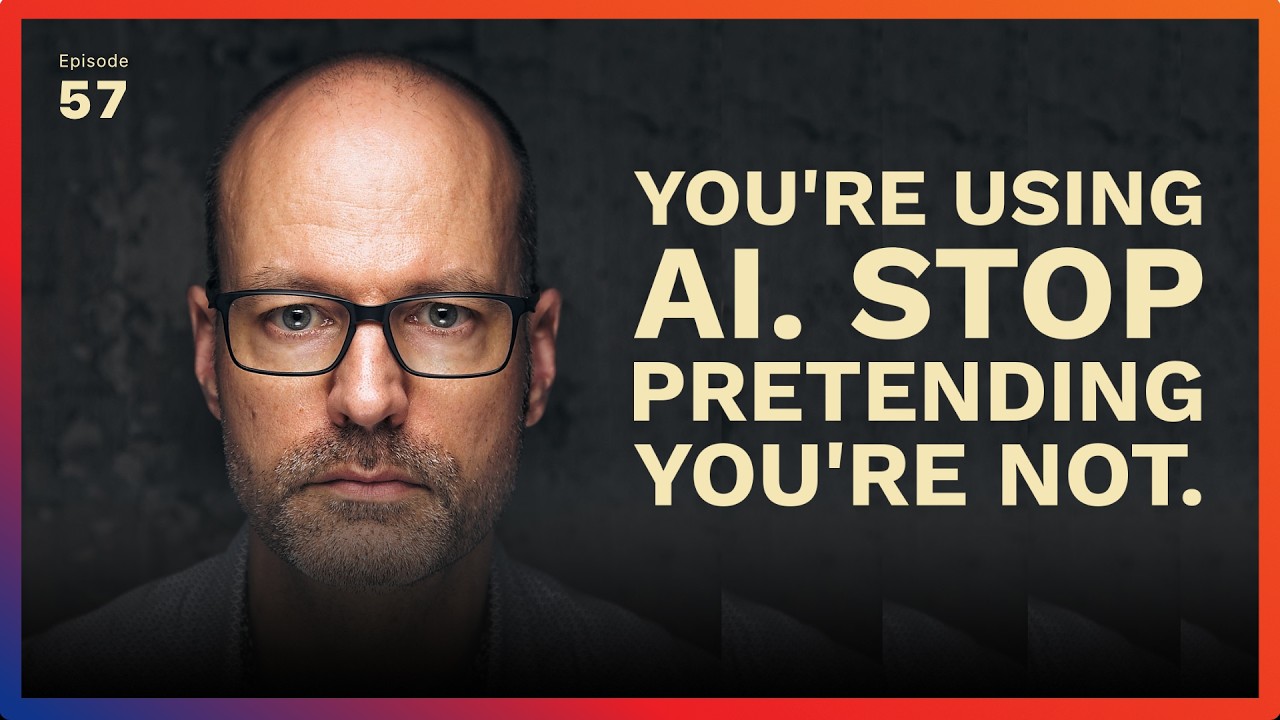
Welcome to Iconoclast Insights. I’m André Daus. And today I want to talk about AI — not the technology itself, but the mess we are making out of how we talk about it, use it, and pretend not to use it.
Because what I am observing right now is not a mature conversation about a new technology. It is a collective performance. And performances, by definition, are not honest.
Let me give you the full picture.
The Badge
A community of web developers created a badge. “Handcrafted by humans. Not AI.” It spread fast. People cheered. It felt like a statement. A stand. An identity marker.
And I understand the impulse. There is something genuinely valuable about human craft. About intentional work. About the individual perspective a person brings to their output that no model can simply replicate. That is real.
But here is what is also true. The same community members who put that badge on their sites are using AI in their workflows. They use it to brainstorm. They use it to generate copy drafts. Some are using AI to copy design patterns from other websites — feeding screenshots into a model and asking it to reproduce the layout. And then they put the badge up.
That is not a stand. That is a costume.
I am not saying this to shame anyone. I am saying this because the contradiction matters. Because the moment you define your position publicly and then privately do the opposite, you are not making a point anymore. You are just making noise. And the world has more than enough of that already.
The Problem With “Use”
Here is what nobody seems to want to slow down long enough to define: what does it actually mean to “use AI”?
Because when the badge crowd says “not AI” — what are they actually saying?
Some people understand “use AI” as: open a chat window, type a vague prompt, copy the output, post it. No review. No context. No judgment. Prompt and publish. That is one definition.
Others understand it as: build a detailed context, apply the right constraints, run the output through your own critical lens, revise it, make real decisions with it — and only then bring it to the world. That is a fundamentally different activity. It requires more skill, not less. It requires you to know enough about your domain to catch what the model gets wrong.
These two things are not the same. They are not even close to the same. But we keep talking about them as if they are.
And this is where the real confusion sits. Not in the technology. In the complete lack of precision in how we describe what we are actually doing with it.
If your position is “I do not blindly publish AI output without review” — that is a valid, interesting, defensible position. Say that. It means something. It describes a real practice.
But “handcrafted by humans, not AI” when you are running prompts three hours a day? That is not a position. That is a contradiction dressed up as a principle.
The Generic Content Problem — And Its Irony
Now let us talk about the content itself. Because I see the complaint everywhere: AI-generated content is generic. It all sounds the same. No perspective, no edge, no real human insight.
And that complaint is often completely correct.
Here is the irony. Who is generating that generic content? The same people making the complaint.
The problem is not the AI. The problem is insufficient context.
When you give a model a vague prompt, you get a vague answer. When you give it no perspective, you get no perspective back. When you feed it no constraint, no point of view, no domain-specific direction — it defaults to the average of everything it has ever learned. And the average of everything is, by definition, generic.
The content is generic not because AI makes it so. It is generic because the person operating it gave it nothing to work with. The AI is doing exactly what it was asked to do. It was asked to produce content. It produced content. The human in that loop failed to bring the judgment.
This is a skills problem. And a self-awareness problem. But it is being diagnosed as an AI problem. Which means the actual problem will never get solved. Because people are treating the output as the issue when the issue is upstream, sitting with the person who decided a vague prompt was good enough.
The Noise Around the Tools
Let me add another layer, because it fits the same pattern.
Right now, a lot of people online are talking with great authority about AI tools they have either barely used or never used at all. Discussions about which assistant is better, which workflow is optimal, which model is superior — happening at high volume, with full confidence, and often with very little actual usage underneath them.
People are forming strong opinions on products they have seen a YouTube thumbnail of. Debating features that do not exist. Confusing one tool for another entirely. And then sharing those opinions as if they were findings — as if an opinion and a finding are the same thing.
They are not. An opinion is a starting point. A finding is what you arrive at after you have actually done the work.
This is not unique to AI, by the way. The internet has always had this dynamic. But with AI, the stakes are higher because the technology is genuinely complex, genuinely consequential, and the decisions being made about how to use it — and regulate it — will have real effects on real things.
If you are trying to form an actual, grounded view on this technology right now, the current public discourse is almost useless as a starting point. You have to dig past it.
The EU AI Act and the GDPR Shadow
I want to bring in one more thread, because I think it is heading in the same direction.
The EU AI Act. The intention is right. Regulating AI systems based on risk levels. Requiring transparency. Protecting people from high-stakes automated decisions that affect their lives. These are legitimate goals and I am not against them.
But I have watched this process. And I have a concern.
We have been here before.
GDPR had a legitimate purpose too. Data protection. User rights. Corporate accountability. All valid. The execution became a forest of checkbox compliance, consent banner theater, and legal language that most people cannot parse. The companies with legal resources adapted and continued largely as before, just with better cover. The smaller operators drowned in uncertainty. And the average user? They click “accept all” because the alternative is a fifteen-step process and they just wanted to read an article.
The outcome was not what the intention was.
The AI Act risks the same fate. Complex categorization systems that produce compliance theater for large actors and genuine paralysis for smaller ones. Meanwhile the actual behaviors — the opacity, the misuse, the lack of real accountability — continue underneath the paperwork.
Good intention. Complicated execution. And at the end of it, most people still will not understand what it actually means for them.
I hope I am wrong about this. But I have seen the movie before.
What “Critical” Actually Means
I want to be precise about something before I close.
When I say we need more critical thinking about AI, I am not saying we need more people being against it. That is not what critical means.
Critical means multi-directional. It means looking at something from more than one angle before forming a view. It means asking what the incentives are. What the assumptions are. What the actual evidence shows — not just what the loudest voices in your feed are repeating today.
Critical thinking about AI means being willing to say: “This is genuinely useful here. And this is genuinely problematic there.” Not one or the other. Both — where both are true.
The person who says AI is always the answer and the person who puts up a “no AI” badge while using AI all week — they are doing the same thing. They have picked a side and stopped thinking. One side just sounds more progressive right now, so it gets the applause.
What would actually move things forward is slowing down. Defining terms before arguing about them. Being honest about what you know and what you do not know. And being honest — especially — about what you actually do, regardless of what badge you put on your website.
Close
Here is what I want to leave you with.
We are in an early, chaotic, genuinely important period with this technology. The noise is high. The clarity is low. A lot of people — including smart, well-meaning people — are running fast without looking at where they are going.
That is understandable. New things create urgency. Urgency creates shortcuts. And shortcuts create exactly the kind of contradictions we have been talking about today.
But it is also a choice. And you can make a different one.
Slow down. Get precise about what you actually mean. Be honest about what you actually do. And when you form a view, make sure it is yours — not just the one that got the most applause in the last community thread you read.
That is less exciting than a badge. It is considerably less shareable. But it is how you actually think. And right now, thinking clearly about this is more valuable than almost anything else you could contribute to the conversation.
I’m André Daus. This was Iconoclast Insights.
If this gave you something to think about, share it with someone who needs to hear it.
And I’ll see you in the next one.